Leaf blowers, industrial culture, and the Great I Am (part 2)
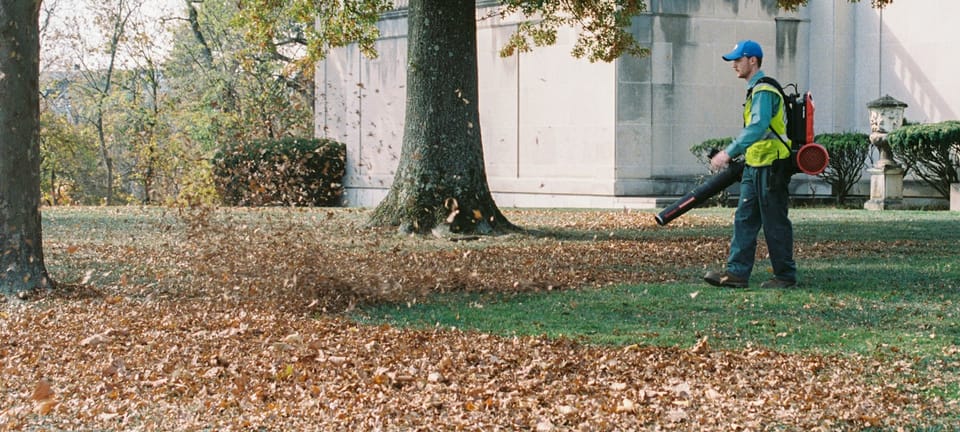
Since I first drafted Part 1 of this post back in 2018, my perspective on leaf blowers—and myself—has shifted. Working with a therapist and studying the Enneagram have helped me to see that some of my habits of mind and body can produce unnecessary suffering in me and distort my vision, including my sense of self. For instance, my mind has a tendency to jump from a concrete situation or problem to its most abstract context (leaf blowers “epitomize the worst of Western Civilization”). This jump facilitates systems thinking, but it also makes it hard for me to stay focused on specific problems. I’m also coming to understand that my drive resides in my gut as much as my head. At the gut level, I have a strong sense of right versus wrong, good versus evil. I like drawing a sharp distinction between the two because I have a fear of being corrupt. In order to remain “good” I must avoid evil in the world (including machines that represent “domination, disregard, and aggression”). I share the second half of my leaf blower story hoping that it might resonate with others struggling to be or do good in an industrial culture.
It all began last year when I cleaned my deck. When we decided to build a deck a few years ago, I did a lot of research to find the best, most sustainable, least evil decking material out there. Happily, I found a solution that seemed pretty perfect: black locust lumber from a local supplier. The downside: it needs to be cleaned, and my wife preferred a lower-maintenance decking material that didn’t meet my sustainability criteria. So I had to prove to her that I could keep this deck looking good.
I spent almost a week scrubbing and power washing the deck. At the beginning of the process I consulted Bob Vila, who told me (via his website) that the best way to keep a deck clean is to remove any debris from it every day. What a great idea, Bob! He also mentioned that the easiest way to do this is with—guess what?—a leaf blower. A week’s worth of hard labor and my poor track record of sweeping the deck daily with a broom made me take this advice seriously.
So I gingerly took a first step onto the slippery slope of moral catastrophe. I began to consider the remote possibility that leaf blowers might actually not be all bad, that they might even be a little bit good. I faced a double bind. I could be virtuous in one of two ways, but not both: either I could continue to boycott leaf blowers and industrial culture or I could be a good deck owner.
I wrestled with what to do for several weeks, and gradually a desire crept into my heart: I started wanting a leaf blower. I wanted to be able to keep my deck clean. I wanted to make my life easier, to speed up a chore. And I wanted to give in and join the people around me, to stop swimming upstream for the sake of virtue. Even the power started to seem a little bit desirable: flip a switch and… shazam!... clean deck!
Still, my fear of being corrupted by industrial culture was strong. Whether or not to buy a leaf blower felt like a serious moral quandary.
By this time I had also begun working with a spiritual director, who encourages me to listen to what God is saying to me. (If “God” language doesn’t work for you, I encourage you to translate if you can.) Now, I’m not in the habit of talking to God and expecting a dialogue, so this was an unfamiliar practice. But one day I tried it. I was walking our dog, perseverating on leaf blowers, feeling miserable. I asked God a question that is a common one for me: what should I do? Help me God! What should I do?
Almost immediately I heard a response, not out loud and not in the form of a burning bush, but in my mind. I heard “I am God.” The “I” was not me, it was God.
I don’t know whether that was really God speaking to me. Maybe it was word association. A few days earlier we sang a song in church with the refrain “be still.” That reminded me of Psalm 46, “Be still and know that I am God.” Maybe it doesn’t matter. My spiritual director says that when we are centered in our true self, our voice and the voice of God are the same. “Be still” spoke to me. I took it to mean relax, slow down, let your heart and mind settle. Listen for the Holy One. Trust in the Holy One.
I began to feel less tormented, less powerful, less responsible for staying strong and resisting corruption. I am not God. I’m a human being. Yes, my actions matter, but I do not have to be perfect. I’m not called to be perfect, and my efforts to be perfect were actually backfiring, diverting energy and attention away from the good I could be doing.

The more I was able to release the strong desire to be morally perfect, the more curious I became about my earlier conviction that leaf blowers are evil. I realized that my conviction had less to do with leaf blowers and more to do with rule following. I have always liked following rules. I find rules comforting because they tell me what I should do and alleviate anxiety. They are guardrails that prevent disaster. One of my rules was “you should not use leaf blowers because they represent the evils of industrial culture and if you use them you will be tainted by that evil.” It sounds ridiculous when it’s fully spelled out, but it was a rule I believed and committed to following. I wanted to stay on the side of good.
Perhaps I have idolized rules, turning them into a god. I’m like those legalistic Pharisees who kept trying to trap Jesus. Those rule followers are not the heroes of the gospel story! Rather, they represent a false way to righteousness that contrasts with the way of Jesus. God is God, the Great I Am. The rules are not God, nor are the rule followers.
With clearing skies above me, I began researching leaf blowers. I searched for the quietest leaf blowers and discovered that battery powered leaf blowers emit no fumes. Battery production itself is bad for the environment, and our electricity mostly comes from fossil fuels, but there are ways to sidestep these problems.
And so I did it. I bought a leaf blower! I bought the quietest machine I could find. To reduce production costs, I bought it third-hand from a guy reselling merchandise that had been opened and returned. I also bought a used battery on eBay. I charge the battery using a portable solar panel. So I feel like I’m a pretty responsible owner of a leaf blower.
And oh boy, do I love blowing the leaves off my deck! It takes about two minutes. It’s quiet (quieter than a hair dryer) and effective. I still compost the leaves in my yard, and I still use brooms and rakes for other jobs. I love keeping my deck clean(er). And I love feeling like I can relax my ethical vigilance just a little bit. This relaxation is spilling over into other areas of my life. Sometimes it feels like a slippery slope to hell, but most of time I trust myself and trust the Spirit of God in me. I am not God. I’m not a prosthetic god wielding a powerful machine. Nor am I a god of moral purity. What a relief.
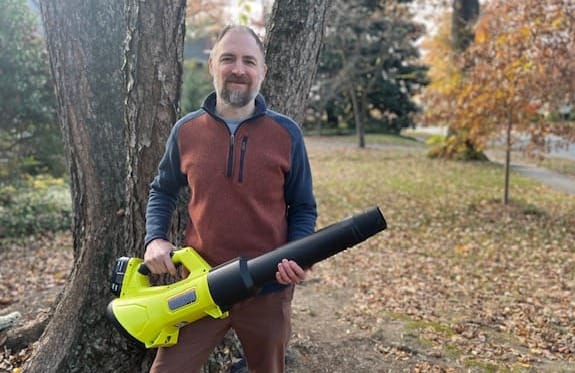
The moral of this story is not “go out and buy a leaf blower!” I still believe these machines exemplify industrial values. Rather, what I’m learning is to quiet my mind, to be still, and to listen. I can release what is not mine to carry. I trust that the Spirit of God is in the trees, in the falling leaves, in the minds of engineers who design useful tools, and yes, in me.